
Learning English Between Two Worlds

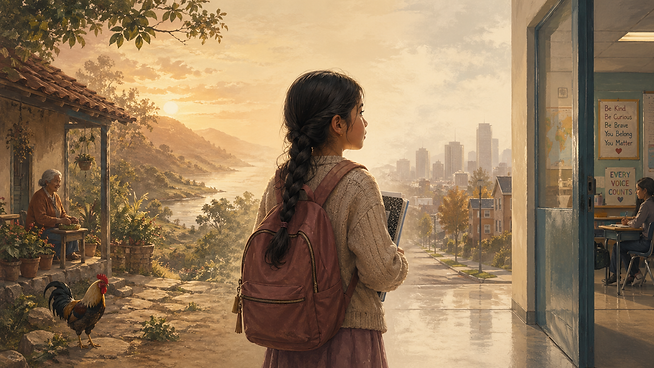
I came to this country as a child — too young to fully understand everything I was leaving behind.
I did not know the language. I only knew the world that had shaped me: my culture, my family, my home in Ecuador, and the rhythms of a childhood that already lived deep within me.
Then, suddenly, everything changed.
I was no longer waking up to the sound of the 5 a.m. rooster.
No longer waking up to my grandmother’s café con leche and bolón.
No longer breathing in mornings that smelled fresh and full of promise.
No longer surrounded by el campo, by cousins playing near the river, by the kind of closeness that makes childhood feel whole.
All of that was left behind.
It was a decision made for me, and I know now that it was made with love. It was made so I could have a better future. But even when something is done for your good, it can still come with grief.
The little girl in me knew loss before she ever had the words to explain it.
Coming to the United States at such a young age was disorienting. I had been fully formed within my culture, and suddenly I was living in a place that felt unfamiliar in almost every way.
I remember going to public school and being placed in ESOL classes. I remember meeting other children whose lives had also been uprooted, and finding a quiet kind of comfort in that shared experience. But I also remember how hard it was to begin again in a language that was not my own.
We were not allowed to speak our native language in class because the goal was to practice English. I understand the intention now. But there is something painful about being separated from the language that first held your thoughts, your humor, your feelings, and your sense of self.
I remember tasting new foods that did not taste like home. It was not my mother’s seco de pollo. It was not colada. It was not the food that carried memory, comfort, and belonging.
And I remember something else, too.
I felt like I was living inside a movie.
So many of the adults around me looked like the people I had only seen on television. As a child, that made everything feel even more surreal. This new world did not just sound different. It looked different. It moved differently. It felt like I had somehow stepped into a place that did not yet belong to me — and maybe I did not yet belong to it either.
Still, beneath all of that, I missed my mother.
I missed my grandmother.
I missed the life I had known.
I missed the sound of morning.
I missed the ease of belonging.
I missed the world that had raised me before I was old enough to understand I was losing it.
Now, I lived in the city.
Walking was not common the way it had been back home. The neighborhoods felt far apart, even when they were close. Friendship did not come easily. And because I did not fully understand the language, I was bullied a great deal in middle school.
That part stayed with me.
I knew I was smart. I had always been smart in Spanish. In many ways, I still think and feel deeply in Spanish. But at that age, I struggled to translate my intelligence into a language I was still learning.
There is something painful about knowing your mind is capable while feeling unable to fully express it.
In some ways, I still carry that tension.
By the time I got to high school, I was fluent in English.
But that fluency did not come overnight.
It came through effort.
Through adaptation.
Through surviving the in-between.
And once I became fluent, another part of the journey began. I was able to travel back to Ecuador and spend my summers there with a tutor, with the hope that when I returned to school in the United States, I would come back ahead.
At least, that was the goal.
But returning was not simple either.
It was not the same Ecuador I had left behind as a little girl.
My mother was no longer there.
The country had changed.
The people had changed.
The places had changed.
And I had changed too.
That is one of the quiet heartbreaks of immigration and grief.
Sometimes you spend years longing for what was left behind, only to realize that when you return, it no longer exists in the way you remember it.
I longed for my childhood.
For the Ecuador that lived in my memory.
For the version of home untouched by time, loss, and change.
For the girl I had been before life began asking so much of me.
But life does not let us remain in one place forever.
So I kept going.
I made the decision that I would make something of myself. I would not allow language barriers, bullying, grief, or displacement to define the whole of my story. They shaped me, yes. But they would not be the end of me.
Years later, that same little girl who once struggled to find her voice in English would raise her right hand and serve in the United States Air Force.
That is not a small thing.
As I reflect during Immigrant Heritage Month and on Women Veterans Day, I see both journeys as part of the same story — the immigrant child who learned to adapt, and the woman veteran who learned to lead, serve, and stand with purpose.
Looking back now, I can see that immigration asked a great deal of me at a very young age. It asked me to adapt before I was ready. To grieve while learning. To build a life while still carrying another one inside me.
But it also gave me something.
It gave me perspective.
It gave me resilience.
It gave me range.
It gave me the ability to live between worlds and still keep going.
Even now, there are parts of me that belong to both places.
There is the little girl shaped by Ecuador, by el campo, by family, by Spanish, by memory, and by longing.
And there is the woman who learned how to survive change, build a life here, serve this country, and carry her story with dignity.
Both are me.
And perhaps that is what I have learned most deeply:
Belonging does not always come from fitting perfectly into one world or another.
Sometimes, belonging comes from learning to honor all the places, losses, languages, and lives that shaped you.
I came here for a better future.
But I also came here carrying a whole world behind me.
And I still do.
Rise. Rebuild. Become.
Zully Gisella Goya Paz
Founder & CEO | GiMeZu


Comments